
Currently, companies collect data from various sources like cloud storage, customer interaction software, operational systems, and live digital communication channels. Large quantities of data create problems for most companies. Many companies use slow reporting processes that make analyzing the data unwieldy and result in poor visibility throughout the departments.
These issues result in delayed decision-making and operational inefficiencies. Reports show that nearly 70% of businesses struggle with managing growing data volumes, while global data creation is expected to exceed 180 zettabytes by 2025. This highlights the increasing need for scalable and efficient data management systems.
This growing complexity is now pushing demand for more advanced Microsoft fabric consulting services, which help companies merge their analytics and data operations into one environment. Today’s enterprises really want platforms able to pull together engineering, analytics, reporting, and AI-driven insights all at once, without adding new infrastructure headaches.
Microsoft Fabric has advanced features to allow organizations to streamline and consolidate their data operations, enhance their reporting, and construct an analytics architecture for sustained and scalable growth into the future.
What Is Microsoft Fabric?
✦ Understanding Microsoft Fabric
Microsoft Fabric is a unified cloud analytics platform that merges data engineering, business intelligence, real-time analytics, and data integration into one bigger ecosystem. In practice, it helps organizations sort out and streamline data workflows while also making it easier for different teams to collaborate, even when they are on separate projects. With the seamless integration across Microsoft tools, Azure services, and AI abilities, businesses that use a modern Microsoft Fabric service can handle, study, and visualize enterprise data more efficiently.
✦ Core Components of Microsoft Fabric
⇒ Data Factory
Data Factory simplifies large-scale data integration by stitching together a bunch of business systems, cloud platforms, and databases into one centralized workflow. It automates data movement, transformation, and orchestration, so organizations can boost operational efficiency while also cutting down manual workloads. A lot of teams now rely on Microsoft Fabric consulting services to design dependable, scalable data pipelines and keep everything flowing.
⇒ Data Engineering
The Data Engineering component lets organizations process, transform, and handle huge datasets in an efficient way. It makes room for advanced analytics workloads, and in general, helps businesses build scalable architectures for both structured and unstructured data. With help from experienced Microsoft Fabric consultants, companies can optimize the performance while also boosting data accessibility across operational and analytics environments.
⇒ Data Science
Microsoft Fabric comes with built-in data science features that help support machine learning, predictive modeling, and AI-driven analytics. In practice, businesses can look at trends, handle automated forecasting, and discover insights that feel practical, using centralized datasets that stay together. This part also supports a faster pace of innovation, while at the same time strengthening strategic planning through smarter analytics and advanced data-guided decisions across different departments.
⇒ Data Warehouse
The Data Warehouse component works as a centralized spot for storing and managing enterprise-scale data securely. It helps with fast querying, better reporting, and smoother analytics workflows, altogether. In practice, organizations can pull information from multiple systems into one shared environment, which can boost consistency and governance, plus strengthen business intelligence outcomes. It also backs long-term scalability and overall operational growth goals, even when things start getting busier.
⇒ Real-Time Analytics
Real-Time Analytics gives organizations a way to handle and read live streaming data, so you get immediate business insights. It lets teams watch how operations are going, how customers are responding, and how the whole system is behaving without having to wait around. Companies that work with advanced Microsoft Fabric analytics can pivot more quickly when operational changes show up, they can improve their decision-making, and they keep a better, broader overview across these ever-moving business environments.
⇒ Power BI Integration
With native Power BI integration, businesses can create interactive dashboards, visual reports, and real-time analytics right inside the Microsoft Fabric ecosystem. Teams can share insights across departments without much fuss, while also sharpening reporting accuracy and honestly making collaboration feel smoother. Overall, this connection helps organizations change raw data into meaningful business intelligence, which then supports smarter day-to-day operations plus strategic choices.
Why Partner with a Microsoft Fabric Consulting Expert
◈ Customized solutions for your business
Specific goals and constraints lead to unique challenges for each organization. Expert Microsoft Fabric consulting experts create custom solutions to each scenario, enabling the construction of versatile analytics environments that optimize workflows, enhance operational efficiency, and provide insight-driven inter-departmental and enterprise operations.
◈ Faster implementation timelines
Formalized implementation strategies empower consulting teams to speed up the deployment of systems. The automation of analytics dashboards and system integrations increases operational systems and process reporting, empowering the use of real-time advanced reporting without the need for lengthy deployments or service interruptions.
◈ Reduced project risks
Enterprise analytics projects involve migration tasks, security controls, and system integration complexities that often undermine performance stability. A dependable Microsoft Fabric consulting company helps reduce those risks through careful planning, governance frameworks, and proven deployment methods, so organizations sidestep operational hiccups, compatibility problems, and expensive implementation mistakes while they push through digital transformation programs.
◈ Better ROI from data investments
Optimized analytics environments help businesses get the most out of their technology investments, in a way that boosts reporting accuracy, adds some operational visibility, and makes automation efficiency work much more smoothly than before. The automation of business processes and the focus of data efforts minimizes duplication, increases efficiency, and supports faster decisions. Consequently, this offers improved returns from enterprise analytics and cloud modernization efforts.
◈ Long-term digital transformation support
A solid digital transformation isn’t only about the first setup; it needs ongoing improvement and scaling readiness after go-live. Using seasoned consultants, you get continuous guidance, system upgrades, steady performance monitoring, and future-leaning roadmaps that help companies adjust to changing day-to-day requirements, while still keeping data environments secure, scalable, and effective for lasting growth. In other words, it keeps everything adaptive, even when operations get more complex.
Also Read: Top Data Engineering Company in USA: Key Services Explained
How to Choose the Right Microsoft Fabric Consulting Company
✦ Evaluate Technical Expertise
Pick a consulting partner with Microsoft-certified talents, focused on cloud analytics, enterprise integration, and scalable data architecture. A knowledgeable Microsoft Fabric consultation service can help you with the least amount of disruption, ensure performance optimization, and offer a facility to deploy what is required for your business and adapt to changing operations.
✦ Check Industry Experience
One of the benefits of specific industry experience is a consulting provider’s ability to offer insights on certain operational challenges, most engagement compliance standards, and even reporting requirements. Building a portfolio of metrics and engagement case studies can provide your business with evidence to support that the partner offers a listed transformation in the analytics of all comparable industries.
✦ Look for End-to-End Service Offerings
A good consulting firm should offer both strategy and end-to-end support for implementation, optimization, and maintenance. Managing all services with one partner maintains a higher level of project consistency and complete communication, which helps build sustainable growth partnerships for the long term, even as the goals for digital transformation progress and the needs for continual support increase.
✦ Consider Support & Scalability
The market is ever-changing, and long-term success depends on the ability to continually optimize, maintain flexible engagement, and scalable infrastructure. Businesses should consider partners that provide ongoing monitoring and performance upgrades and deliver reliable Microsoft Fabric solutions to support your organization’s analytics and address the growing workloads, evolving technology, and advancing operational needs.
Key Features of Microsoft Fabric for Scalable Data Management
◈ Unified Data Platform
Microsoft Fabric creates a platform that centralizes every function, from advanced analytics and consolidated reporting to unified data management. Qualified Microsoft Fabric specialists can help your business collaborate, eliminate data silos, and optimize operations across the organization.
◈ AI-Driven Insights
The built-in AI and machine learning embedding simplifies forecasting and intelligent analytics. When insights become automated, it allows businesses to be ahead of the game and quickly plan operations and determine smart strategies with improved analytics.
◈ Real-Time Data Processing
With real-time analytics, organizations can handle live data immediately, so business decisions happen faster and with less lag, and are more responsive. In practice, companies that use Microsoft Fabric services in Chicago can react to operational shifts quickly and gain sharper performance visibility across their various teams, not just one area.
◈ Enterprise-Level Security
Microsoft Fabric offers high-level governance, compliance guardrails, and a secure cloud foundation to protect enterprise data even when things get messy. With role-based access management, plus security monitoring, organizations can stay in line with the regulatory requirements and better protect sensitive business information.
◈ Scalability for Growing Businesses
With a flexible cloud-based infrastructure, organizations can scale storage, analytics, and processing capabilities depending on real operational demand. Teams can expand workloads without big infrastructure changes, and without running into obvious performance limitations as the amount of data keeps growing.
End-to-End Microsoft Fabric Consulting Services
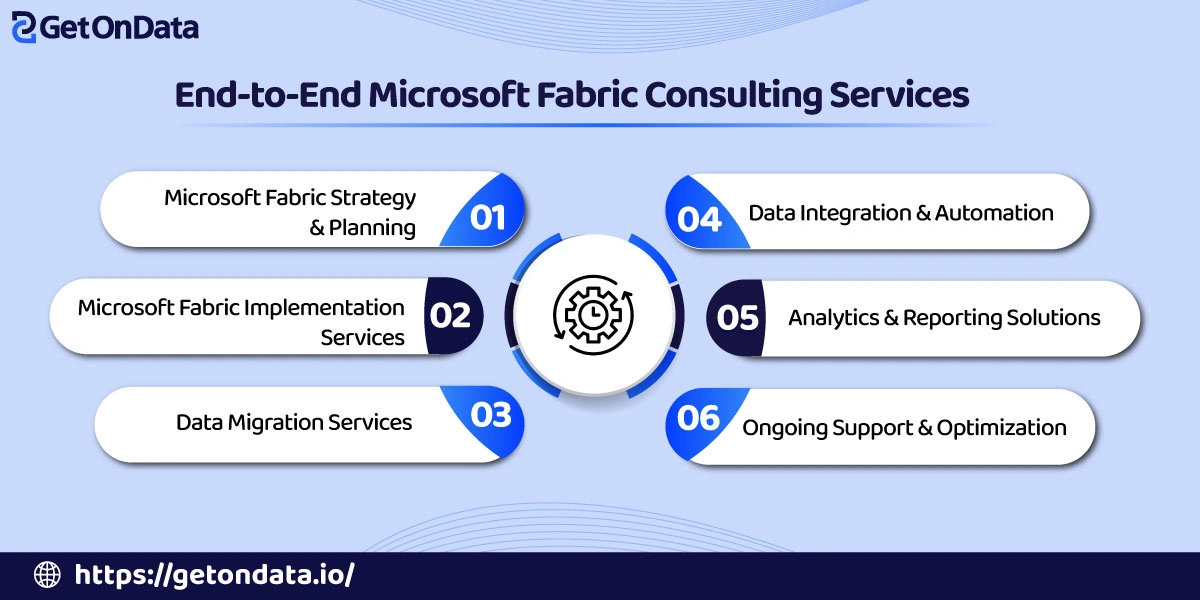
✦ Microsoft Fabric Strategy & Planning
A successful implementation really starts with strategic planning; it should be tied to the company’s business goals and the day-to-day operational needs. That part includes a few assessments, then building a roadmap, and virtually handling architecture planning. From there, you focus on scalable analytics strategies, so it can support long-term digital transformation, plus ongoing operational growth.
✦ Microsoft Fabric Implementation Services
The implementation services cover things like platform configuration, secure pipeline building, warehouse setup, plus the Power BI connection. Experienced Microsoft fabric specialists assist organizations in a way that helps them streamline the deployments, raise analytics performance, and build centralized environments that support faster reporting, collaboration, and a smoother day-to-day workflow.
✦ Data Migration Services
Data migration services help with secure moves from older systems to cloud-based environments with little downtime. A dependable Microsoft fabric service helps with precise transfers, keeps the data consistent, and lowers operational disruptions during the whole migration.
✦ Data Integration & Automation
Data integration services utilize API, automation, and instantaneous synchronization to link applications, cloud systems, and operational platforms. This simplifies workflows, minimizes manual processes, and enables more agile data-oriented business processes across the organization.
✦ Analytics & Reporting Solutions
Advanced analytics capabilities take complex data sets and offer insights through rich dashboards, KPI and predictive reporting. Real-time visibility empowers businesses to operate more efficiently and keep track of performance to support proactive and strategic business decisions.
✦ Ongoing Support & Optimization
With ongoing optimization services, you keep an eye on platform security, scalability, and overall performance through routine monitoring, infrastructure management, upgrades, and system enhancements. At the same time, continuous support helps organizations adapt more smoothly to changing operational needs and enterprise technology requirements. Over time, this keeps things consistent, stable, and ready for what comes next.
Industries Benefiting from Microsoft Fabric Consulting Services
◈ Healthcare
In healthcare, organizations use Microsoft Fabric like a bridge to improve patient data analytics, boost compliance management, and streamline reporting processes while keeping secure and centralized healthcare information systems running smoothly, efficiently, and with the necessary control.
◈ Retail & E-commerce
Retail and e-commerce teams use Microsoft Fabric to better understand customer behaviors, adjust stock planning, sharpen demand forecasting, and bring up more customized shopping experiences with advanced analytics. It’s basically a way to connect data and make decisions faster, even when things change quickly.
◈ Finance
Finance companies use Microsoft Fabric for fraud detection, risk analysis, compliance submissions, and continuous, real-time financial monitoring. The idea is to boost security, raise precision, and support operational choices in practice, more effectively, even when data is fast and changing.
◈ Manufacturing
Manufacturers can make supply chain visibility better, keep an eye on production efficiency, and lower equipment downtime by using predictive maintenance solutions. A lot of enterprises end up adopting Microsoft Fabric services in Chicago to get scalable operational analytics.
◈ Logistics & Transportation
Logistics companies use Microsoft Fabric for real-time shipment tracking, route optimization, and reporting that’s more operational and consistent. They also use it for performance monitoring, so deliveries get more efficient and the whole coordination side of the supply chain stays in sync.
Also Read: Complete List of Power BI Analytics Services for Business Growth
Future Trends in Microsoft Fabric & Data Management
AI and automated analytics are changing standard workflows. The ability to analyze real-time data and create instant reports translates to more efficient and quicker decision-making. Companies are also unifying their data platforms and streamlining their analytic systems to improve the collaborative efforts of their enterprise data and create flexible, scalable ecosystems to improve efficiency.
Transform Your Data Strategy with Microsoft Fabric Consulting Services
Microsoft Fabric gives companies integrated analytics, faster real-time insights, a flexible cloud infrastructure, and a simplified data management system.
Collaborating with a reliable Microsoft Fabric company in Chicago allows organizations to modernize older systems, enhance operational systems, and create secure and scalable growth for data-based analytics systems for future adaptive enterprise operations.

