
Enterprises generate large amounts of data, which contains valuable metrics, and data analytics is the way to unlock them. Data analytics supports firms in customizing their marketing pitch and individual customer offerings to address and mitigate risks. Most businesses find it tough to build a strong, data-backed culture, and they don’t use data for decision-making. Yes, there are challenges when making a sudden shift, but it also offers plenty of benefits. Data analytics helps businesses gain a better understanding of users’ needs, preferences, and behaviors for delivering personalized solutions. Data becomes the most important part of modern firms, allowing them to measure opportunities. With the ideal custom data analytics solutions, firms can harness real-time data to enhance operational efficiency and employee satisfaction.
According to McKinsey & Company, businesses using customer analytics effectively are 2,200% more likely to acquire customers and 800% more likely to achieve stronger customer loyalty. Organisations that fail to adopt data-driven approaches risk falling behind.
Adopting the ideal data insights allows firms to make smart decisions rather than spending unnecessary time on guesswork. It can be used to identify new opportunities, mitigate risks, and optimize organizational processes for improved efficiency and cost-effectiveness.
This blog explores how data analytics support organizational development, allow firms to align strategies with goals, make evidence-based decisions, and obtain long-term growth. We have also discussed the benefits of data analytics that help firms reshape their organizational operations.
What Is a Data-Driven Organization?
A company that uses data as the main basis for decision-making, strategy development, and enhancing daily operations is known as a data-driven organization. These organizations gather, evaluate, and interpret data from several sources in order to obtain significant insights rather than depending on presumptions, gut feelings, or out-of-date information. Customer, sales, marketing, financial, operations, supply chain, and employee performance data are all included in this. Converting unprocessed data into useful intelligence that promotes improved company results is the aim.
Dashboards, reports, and analytics tools provide employees and decision-makers in a data-driven company with accurate, dependable, and current information. Teams can measure business performance and track trends through this. Organizations may reduce risks, increase productivity, and find new growth opportunities by basing decisions on quantifiable evidence.
Implementing cutting-edge technology is only one aspect of being data-driven; another is creating an environment where workers at all levels respect data and utilize it to inform their choices. To guarantee that information is accurate and available, strong data governance, quality control, and departmental cooperation are equally crucial. Organizations may enhance customer experiences, optimize operations, fortify strategic planning, boost profitability, and obtain a long-term competitive advantage in today’s rapidly evolving digital business environment by adopting a data-driven approach.
Why Is Data Analytics Important for Modern Organizations?
Every day, modern businesses produce massive amounts of data from operations, finance, marketing, workers, consumers, and digital platforms. However, data only gains value when it is converted into insightful knowledge that informs business choices. Organizations can use data analytics to decipher complicated information, identify trends, and make choices based on facts rather than speculation. Some more benefits of data analytics in business are that it helps executives identify chances for expansion and innovation, react swiftly to shifts in the market, and comprehend company performance in real time.
The benefits of using data analytics are that businesses can enhance consumer experiences, streamline processes, and achieve long-term success as competition grows. Additionally, a lot of companies collaborate with data analytics service providers to develop scalable reporting systems, combine various data sources, and use advanced analytics solutions. Organizations may enhance cooperation, boost productivity, and build a solid basis for ongoing development and strategic decision-making by making data available and actionable across divisions.
Here are the benefits of data analytics for business-
✦ It streamlines a range of organized & fragmented information into insightful knowledge that helps make smarter business decisions.
✦ It reduces uncertainty in strategic decision-making by empowering executives to assess opportunities and facts rather than assumptions.
✦ Another benefit of big data analytics in business is that it enables organizations to adjust more quickly by keeping an eye on consumer behavior, market developments, and operational performance in real time.
✦ It gives information on consumer preferences, purchasing habits, and engagement patterns, allowing for more individualized goods, services, and advertising tactics.
✦ It promotes operational efficiency by discovering resource inefficiencies, process bottlenecks, and opportunities for workflow optimization to boost output and cut expenses.
Key Benefits of Data Analytics for Building a Data-Driven Organization
1. Enables Faster and More Informed Decisions
Experts can make decisions based on real-time metrics rather than speculation thanks to the benefits of data analytics for businesses. It provides organizations with instant access to trustworthy business information. Decision-makers can use precise data to compare different strategies, assess current performance, and determine the most effective plan rather than depending on outdated data. Critical information is always accessible thanks to real-time dashboards and interactive reports, which enable companies to react swiftly to shifting market conditions. This results in increased confidence in strategic choices, decreased ambiguity, and enhanced agility.
Data-driven insights reduce uncertainty and enhance results when launching a new product, modifying pricing, or monitoring operations. Analytics promotes a culture where every significant business decision is backed by measurable data by providing leaders with reliable information. This leads to more intelligent planning, improved performance, and better long-term economic success.
2. Improves Operational Efficiency
Organizations can find inefficiencies that slow down processes and raise expenses by using data analytics. Businesses can identify delays, get rid of repetitive operations, and remove process bottlenecks by assessing workflows, resource usage, and operational performance. The big data analytics service providers help to streamline processes, enhance departmental cooperation, and make sure resources are distributed where they will have the biggest impact.
By identifying manual procedures that can be optimized, analytics also helps automation initiatives. Organizations can assess operational performance in real time and make changes before minor problems worsen by using continuous monitoring. Higher employee productivity, quicker service delivery, and lower operating costs are all results of increased efficiency. Data analytics helps organizations maximize productivity while preserving quality by making processes more transparent and quantifiable. This results in a more flexible and economical corporate environment that promotes long-term success.
3. Creates a Better Understanding of Customers
By gathering and analyzing data from various client touchpoints, data analytics enables businesses to uncover demographics, engagement behaviors, preferences, and purchase trends. Instead of making generalizations, these insights assist companies in developing relevant client categories. Businesses may enhance client communication, tailor marketing campaigns, and provide more relevant experiences through digital and physical channels with improved segmentation.
Additionally, by identifying customer pain points, analytics enables organizations to improve their offerings, raise customer satisfaction, and improve service quality. Businesses that use analytics are better able to adapt to shifting customer expectations and build closer bonds with their clients. In the end, this deeper comprehension supports more focused company initiatives and increases client loyalty, retention, and lifetime value.
Also Read : Best Data Analytics Company in Chicago (2026 Guide)
4. Strengthens Strategic Planning
Rather than relying on guesswork, successful business plans rely on precise facts. Leaders can assess past performance while reacting to current market situations thanks to the business benefits of data analytics. It gives businesses access to both historical performance data and real-time insights. Analytics assists companies in creating measurable objectives and accurate forecasts by identifying trends, patterns, and business prospects. Because decisions are backed by quantifiable information rather than speculation, strategic planning becomes more reliable.
Before making long-term expenditures, companies can also evaluate internal strengths and weaknesses, track industry developments, and assess competition performance. Organizations that have constant access to performance indicators are able to evaluate their strategies on a frequent basis and modify their plans in response to shifting market conditions. This increases adaptability and lowers the possibility of making bad strategic choices. In the end, analytics helps companies create sustainable practices.
5. Identifies New Growth Opportunities
Organizations can find opportunities in vast amounts of corporate data by using data analytics. Businesses can uncover profitable items, high-value client categories, and growing market demands by researching consumer behavior, purchasing trends, and market performance. Additionally, analytics identifies unexplored niches where businesses might expand their current offerings or launch new ones. Data analytics service providers offer insights that provide measurable facts to boost innovation and lessen uncertainty when assessing business expansion options.
Before making strategic investments, businesses can evaluate customer feedback, keep an eye on competition activities, and spot shifting consumer preferences. Organizations may pick opportunities with the highest potential return while reducing unnecessary risks thanks to data-driven innovation. Businesses that use analytics can keep a competitive edge and react to new demands more quickly as markets continue to change. Through wise decision-making, this promotes long-term business development and permits sustainable income growth.
6. Improves Financial Performance
Accurate visibility into revenue, expenses, profitability, and operating costs is essential for financial success. Data analytics gives businesses comprehensive financial insights that enable executives to see where money is coming from and where unnecessary expenditure takes place. Without compromising operational performance, businesses can assess product profitability, track cash flow, and find ways to save costs. By utilizing both current business patterns and past financial data, analytics also facilitates more precise budgeting.
Organizations are able to make better investment decisions and allocate resources efficiently. Ongoing financial monitoring guarantees that financial performance is in line with business goals and assists in identifying unusual spending trends. Analytics enhances reporting accuracy and strengthens departmental financial planning by providing trustworthy financial data. In the end, improved financial visibility enables businesses to maximize profits, cut waste, and make wiser investment choices that support long-term stability and sustainable growth.
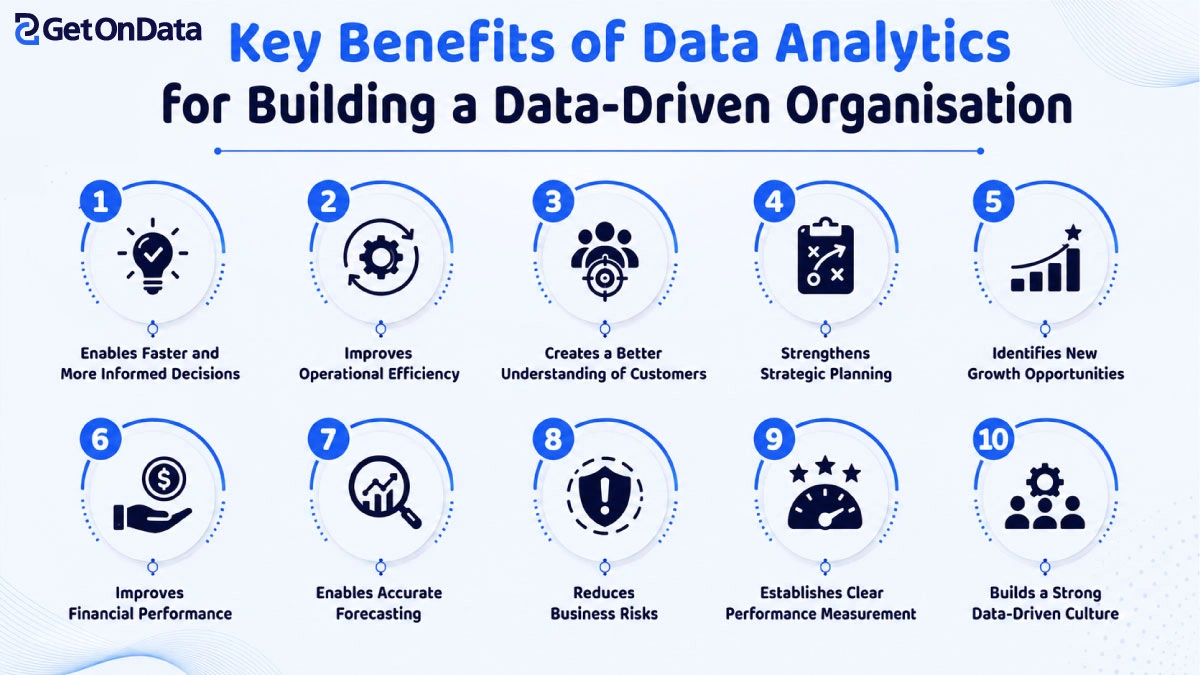
7. Enables Accurate Forecasting
When businesses use real-time and historical data rather than depending only on assumptions, forecasting becomes far more reliable. To more accurately forecast future results, data analytics examines past performance, consumer behavior, market trends, and operational variables. Companies are better able to predict revenue estimates, staffing demands, inventory needs, and sales demand. These forecasting insights assist businesses in anticipating seasonal variations, shifting consumer demands, and possible market disruptions.
By lowering uncertainty, improved forecasting also helps with supply chain management, production scheduling, and budgeting. Forecasts are based on measurable evidence rather than speculation, which gives decision-makers more confidence when planning future company actions. Organizations stay flexible and can swiftly modify plans as conditions change by regularly adding fresh data to predictive models, which enhances resilience and overall company success.
8. Reduces Business Risks
Risks related to operations, finances, compliance, and cybersecurity can have an impact on an organization’s long-term success. By regularly observing corporate operations and detecting odd trends, data analytics assists companies in identifying possible dangers earlier. By identifying suspicious transactions and irregularities that can point to financial irregularities, analytics helps in the detection of fraud. By monitoring corporate procedures against internal policies and industry standards, it also improves regulatory compliance.
Organizations can take proactive measures before issues worsen by using predictive analytics to predict possible interruptions. Dashboards for risk monitoring give executives a better understanding of operational performance, which facilitates rapid responses to new problems. Organizations can enhance governance, lower financial losses, and increase business continuity by identifying vulnerabilities with trustworthy data. This proactive approach to risk management increases resilience and safeguards customer trust as well as organizational performance.
9. Establishes Clear Performance Measurement
By connecting strategic goals with quantifiable KPIs, data analytics helps businesses monitor business success consistently. Leaders can use precise dashboards, reports, and real-time performance data to track progress rather than depending on personal assessments. Departmental performance, staff productivity, revenue growth, customer satisfaction, and operational efficiency are all visible through analytics.
These insights assist companies in identifying areas that need improvement while acknowledging projects that are successful and produce measurable results. Because teams can easily see how their work contributes to organizational goals, transparent performance reporting also fosters more accountability. Frequent monitoring enables managers to promptly close performance gaps, which promotes continual improvement. Businesses may assess the efficacy of initiatives, maximize resource allocation, and guarantee that every department stays in line with overall company goals.
10. Builds a Strong Data-Driven Culture
Employees at all levels are encouraged by a data-driven business to support choices with solid evidence rather than personal judgments. Teams may easily access consistent information thanks to custom data analytics solutions, which promotes a departmental understanding of business performance. Regular use of dashboards, reporting, and analytics tools by staff members makes decision-making more transparent and cooperative.
By enabling teams to assess results, gauge performance, and enhance procedures using measurable insights, this culture promotes ongoing learning. By guaranteeing that all departments use the same reliable data, it also lessens departmental inconsistencies. Organizations strengthen their analytical capabilities, which promote innovation and operational excellence. A data-driven culture eventually increases organizational agility, strengthens responsibility, and allows companies to quickly adapt to shifting market conditions while preserving long-term, sustainable growth.
Also Read : Top Data Analytics Companies in Houston to Watch in 2026
How Different Departments Benefit from Data Analytics
❏ Marketing and Sales
By using data analytics to make evidence-based decisions, marketing and sales teams can better understand their target audience, enhance campaign performance, and boost revenues. Businesses may develop highly focused consumer segments for individualized marketing efforts by studying client demographics, browsing habits, past purchases, and involvement across several media. This lowers unnecessary marketing costs while increasing consumer acquisition, engagement, and conversion rates.
Additionally, analytics track campaign effectiveness in real time, enabling teams to determine which content, ads, and channels provide the best ROI. Lead scoring models help sales organizations prioritize high-value opportunities by ranking leads according to their chances of converting. By integrating market trends, consumer demand patterns, and previous sales data, predictive analytics also enhances sales forecasting.
To deploy advanced analytics platforms that combine sales and marketing data into a single view, many businesses collaborate with big data analytics service providers. Stronger teamwork, better consumer targeting, and steady revenue growth through data-driven tactics are all made possible by this.
❏ Finance
Finance departments may enhance financial visibility, optimize resource allocation, and facilitate more precise decision-making with big data and analytics services. Organizations can obtain a thorough picture of revenue, expenses, profitability, and cash flow by gathering and analyzing financial data from various platforms. By recognizing past spending trends and projecting future financial needs based on company performance, analytics streamlines budget planning.
Finance teams can prioritize successful investments by using profitability analysis to determine which goods, services, clients, or business divisions offer the highest returns. By projecting future income and expenses, predictive analytics also improves cash-flow forecasting by lowering the possibility of liquidity shortages.
Additionally, real-time dashboards that identify unusual transactions, spending patterns, or compliance problems before they become serious issues allow finance professionals to keep an eye on financial risks. Continuous reporting facilitates quicker strategic decision-making and increases financial transparency throughout the company. Businesses can lower expenses, boost operational effectiveness, improve financial planning, and preserve long-term financial stability with precise financial information.
❏ Operations and Supply Chain
Operations and supply chain teams can increase productivity, cut expenses, and guarantee that goods are delivered to clients on schedule with the help of data analytics. Businesses can monitor production performance, find bottlenecks, and improve departmental operations by examining operational data. Because analytics forecasts stock requirements based on past demand, seasonal trends, and purchase behavior, inventory optimization becomes more efficient.
By doing this, excess inventory is decreased, and stock shortages that can lower consumer satisfaction are prevented. Demand forecasting enables businesses to better use resources and cut waste by matching production schedules to expected consumer demand. By measuring delivery timeframes, order accuracy, quality standards, and procurement costs, analytics can assist firms in keeping an eye on supplier performance.
Managers can react swiftly to delays, disturbances, or shifting market conditions when they have real-time visibility into supply chain processes. Organizations may increase efficiency, lower logistics costs, and improve supplier relationships through data analytics services & solutions. They can create a more robust and responsive supply chain that promotes long-term business growth by regularly assessing operational performance.
❏ Human Resources
Data analytics enhances employee engagement and organizational success while assisting HR departments in making better personnel decisions. HR specialists may determine staffing needs, project future hiring requirements, and create efficient workforce planning strategies by assessing workforce data.
Managers may identify great performers and close performance gaps more effectively by using employee performance analysis, which offers insightful information about productivity, training efficacy, and personal growth potential. By determining the most effective hiring channels, assessing candidate quality, and cutting down on hiring time, analytics also enhances recruitment. Predictive analytics makes employee retention more proactive by identifying turnover-causing causes and enabling organizations to launch focused engagement and retention programs before workers depart.
HR departments can also keep an eye on staffing trends and diversity to help with improved organizational planning. Human resources departments can develop more equitable decision-making procedures, enhance employee satisfaction, maximize talent management, and strengthen their staff in line with long-term corporate goals by utilizing data-driven insights.
❏ Customer Service
Customer service representatives can provide quicker, more individualized, and better support experiences thanks to data analytics. Businesses can learn more about consumer expectations, satisfaction levels, and recurring problems by evaluating customer interactions on phone, email, chat, and social media platforms.
Customer sentiment analysis helps businesses enhance customer relationships and service quality by identifying good and negative experiences through feedback, reviews, and support interactions. By monitoring important indicators like response times, first-contact resolution rates, ticket volumes, and customer satisfaction ratings, analytics also keeps an eye on support performance. Managers can maximize personnel levels, boost agent productivity, and optimize service procedures with the use of these data.
By identifying consumers who are likely to discontinue using a product or service, predictive analytics helps organizations take proactive steps to lower turnover. Organizations may enhance customer loyalty, build brand reputation, and provide consistent, data-driven customer experiences across all interactions by consistently monitoring service performance and consumer behavior.
Turn Business Data into Better Decisions and Sustainable Growth
Data analytics is a strong element that restructures the way businesses think. It’s not about gathering numbers or monitoring trends but about promoting adaptability. Integrating data analytics into firm development embraces the potential. Firms that embrace analytics can proactively shape their futures.
Since companies have large quantities of data, they look for tools to derive insights and make data-driven decisions. It allows firms to obtain an improved knowledge of the audience’s preferences. Further, it enables constant optimization that enhances user experience and satisfaction. To embrace all these benefits, hire data analytics service providers today.

