
In today’s data-centric world, real-time data pipelines and data processing systems drive innovation and faster decision-making. A reliable data engineering company uses advanced tools and proven practices to build a robust data foundation, deliver metrics at scale, and help businesses overcome modern data challenges.
As we move towards 2026, emerging data engineering trends are reshaping modern data infrastructure for AI and real-time analytics. With nearly 60% of AI projects expected to fail without AI-ready data, businesses are now focusing on scalable pipelines, automation, governance, and cloud-native systems to improve decision-making and build smarter, responsive operations.
Whether you want to modernize your stack or scale data platforms, the following data engineering trends will shape how to design, build, and operate data systems.
Why Data Engineering Matters More Than Ever in 2026
❏ The Connection Between AI and Data Engineering
AI systems rely heavily on quality, structured, and real-time data to deliver accurate outcomes and reliable predictions. Data engineering services act as the foundation for AI by building scalable infrastructure and automated pipelines that gather, process, and manage efficient data. Without strong data engineering practices, AI models can’t perform effectively.
❏ Real-Time Analytics Becoming a Business Standard
Organizations are frequently transitioning from traditional historic reporting to real-time metrics for quick and smart decision-making. Live data insights support firms in responding instantly to market changes, operational errors, and user behavior. Real-time customization supports user experience by serving targeted recommendations, quick services, and responsive virtual interactions across industries.
❏ Growing Data Complexity Across Enterprises
The advanced enterprises face rising data complications because of multi-cloud infrastructure, frequent streaming data, and connected IoT devices. Advanced data engineering consultants support firms to integrate, process, and measure complicated datasets effectively while managing scalability and performance.

Top Data Engineering Trends in 2026
➥ AI-Powered Data Pipelines & Automation
✦ Key Areas to Discuss
In 2026, data engineering driven by AI will revolutionize how companies handle and analyze data. With little human involvement, intelligent ETL and ELT automation technologies can automatically clean, transform, and transport data. While AI-based monitoring increases operational efficiency, self-healing workflows detect pipeline breakdowns and automatically fix problems. Additionally, companies are using Tableau analytics consulting services more frequently to automate reporting workflows and build intelligent dashboards for improved decision-making and corporate visibility.
✦ Benefits for Businesses
The latest data engineering trends, AI-driven automation, minimize human error in data processing, and lessen the manual workload. Faster pipeline execution, better data quality, and real-time operational insights are all advantageous to businesses. Additionally, automated solutions increase scalability and reduce maintenance costs. The Tableau Analytics consulting services enable businesses to manage a vast amount of data.
➥ Real-Time Data Streaming & Analytics
✦ Key Areas to Discuss
Organizations can rapidly process and analyze information as it is created thanks to real-time data streaming. Continuous data flow from applications, websites, IoT devices, and customer interactions is supported by event-driven architectures. Businesses may obtain real-time insights, automate answers, and create intelligent applications that can handle large data volumes with low latency and excellent performance with the assistance of modern streaming platforms.
✦ Benefits for Businesses
Businesses that use real-time analytics are able to make decisions based on current data more quickly and accurately. Personalized recommendations and quick service delivery are two ways that instant processing enhances client experiences. Additionally, data engineering consulting solutions assist companies in promptly identifying fraud, operational problems, or system breakdowns. It minimizes downtime and facilitates proactive solutions that enhance customer happiness and corporate efficiency.
➥ Growth of Data Lakehouse Architecture
✦ Key Areas to Discuss
Modern businesses are increasingly choosing data lakehouse architecture, the latest trends in data engineering 2026. Organizations can use a single platform to store all data types. For large businesses managing complex analytical workloads, scalable analytics systems simplify data administration while enhancing accessibility, governance, and processing efficiency. These days, a lot of businesses engage data engineering consultants to successfully apply lakehouse techniques.
✦ Benefits for Businesses
Better scalability is provided by lakehouse architecture, which allows firms to manage rising data quantity without hampering speed. Reports and AI model training capabilities are enhanced by faster analytics processing. By combining systems into a single platform, organizations can cut infrastructure and storage costs. The data engineering consultant simplifies operations and effectively supports advanced analytics and machine learning programs.
➥ Vector Databases & AI Search Systems
✦ Key Areas to Discuss
Because vector databases allow for intelligent data retrieval and semantic search, they are becoming indispensable for AI-driven applications. Rather than depending solely on keywords, these systems employ embeddings to comprehend the context and meaning of searches. By fusing reliable external data sources with AI-generated responses, Retrieval-Augmented Generation (RAG) enhances the performance of big language models, resulting in more intelligent search experiences and corporate AI applications.
✦ Benefits for Businesses
Significantly increased AI search accuracy and enhanced contextual understanding in applications are advantageous to businesses. By providing more pertinent responses and quicker information retrieval, vector databases improve chatbot performance. Additionally, businesses may create advanced AI-powered systems for knowledge management, recommendation engines, enterprise search, and customer service while enhancing user experiences and operational effectiveness across digital platforms.
➥ Data Observability & Reliability Monitoring
✦ Key Areas to Discuss
Organizations may monitor data performance, quality, and dependability across pipelines in real time with the help of data observability solutions. These systems offer visibility into the flow of information throughout the company, trace data lineage, and detect irregularities. AI and analytics are used by automated issue detection systems to find anomalies, missing records, or corrupted data before they affect reporting accuracy or business operations.
✦ Benefits for Businesses
Increased confidence in analytics outputs and fewer data-related errors are advantageous to businesses. Reliable monitoring lowers downtime brought on by pipeline failures and increases operational stability. Teams can solve issues more quickly, enhance governance procedures, and guarantee that decision-makers always have access to reliable, accurate, and current business information with improved visibility into data operations.
Also Read: Top Data Engineering Company in USA: Key Services Explained
➥ Edge Data Engineering for Faster Processing
✦ Key Areas to Discuss
Instead of depending solely on centralized cloud infrastructure, edge data engineering aims to process data. IoT systems, smart devices, industrial automation, and real-time applications that need quick processing are all supported by this method. By reducing the need to move large datasets to the cloud, edge computing integration enhances responsiveness and makes effective local data analysis possible.
✦ Benefits for Businesses
When processing vital information close to the source, organizations gain from much reduced latency and quicker reaction times. While enhancing performance for smart devices and linked systems, edge data engineering also lowers cloud bandwidth consumption and operating expenses. Companies in the manufacturing, healthcare, logistics, and retail sectors can support advanced real-time applications and provide superior consumer experiences.
➥ Metadata-Driven Data Management
✦ Key Areas to Discuss
Intelligent metadata systems, the current trends in data engineering, are used in metadata-driven data management. It is used to automate workflow, data governance, and organizational procedures. While smart data catalogs enhance accessibility, automated schema management makes managing complicated information across several platforms easier. Organizations can increase collaboration between technical and business teams working with corporate data systems. It preserves consistency and streamlines pipeline processes with metadata-based automation.
✦ Benefits for Businesses
Centralized metadata visibility simplifies governance and enhances compliance management for businesses. Teams may find pertinent information more quickly and with less duplication because of improved data discoverability. Additionally, metadata-driven operations facilitate greater collaboration, expedite data integration, and increase operational efficiency. It helps organizations manage large-scale data ecosystems more precisely and successfully.
➥ Increasing Adoption of Data Mesh Architecture
✦ Key Areas to Discuss
Instead of depending on centralized data teams, data mesh architecture, the data engineering new trends decentralize data ownership across business domains. Using common governance guidelines and self-service platforms, each department maintains its own data like a product. In addition to increasing scalability, this domain-based strategy promotes cooperation between the technical and operational teams managing corporate data pipelines.
✦ Benefits for Businesses
Businesses that use data mesh gain faster access to business-critical data and increased scalability. Teams do not need to rely on centralized bottlenecks in order to independently manage and analyze their datasets. This strategy promotes departmental cooperation, increases agility, and helps businesses scale analytics and data operations more effectively while fostering innovation and quicker decision-making.
➥ Privacy-First & Secure Data Engineering
✦ Key Areas to Discuss
Data engineering that prioritizes privacy is becoming crucial as companies deal with increasing cybersecurity risks and more stringent regulations. To safeguard sensitive data, organizations are putting encryption techniques, secure data-sharing procedures, and zero-trust security models into practice. Stronger governance structures and ongoing monitoring of data access and usage across systems are necessary to comply with regional and international privacy standards.
✦ Benefits for Businesses
Stronger protection of private client and organizational data is advantageous to businesses. Enhanced compliance lowers the financial and legal risks related to regulatory infractions and data breaches. In addition to fostering ethical data usage and long-term economic viability, privacy-focused engineering helps companies maintain secure digital ecosystems.
➥ Sustainable & Cost-Efficient Data Infrastructure
✦ Key Areas to Discuss
Reducing energy use and maximizing resource utilization in both on-premises and cloud contexts are the main goals of sustainable data infrastructure. Energy-saving processing methods, effective storage techniques, and green cloud computing are emerging as top considerations for businesses overseeing massive data operations. In advanced data ecosystems, businesses are progressively implementing cost-effective architectures that strike a balance between performance, scalability, and environmental responsibility.
✦ Benefits for Businesses
Through improved resource management and decreased energy consumption, organizations gain from cheaper infrastructure and operating expenses. Additionally, sustainable systems increase overall efficiency and assist business environmental goals. Businesses can maintain high-performance data operations while lowering their environmental impact.
Industry Use Cases of Real-Time Data Engineering
⇒ Healthcare
Real-time data engineering is revolutionizing healthcare through predictive patient tracking and AI-driven diagnostics. Healthcare centers can frequently monitor patient vitals through connected devices and measure data instantly to monitor health complications early. The AI-driven systems support doctors in making faster & accurate diagnoses, enhancing treatment results, and improving overall patient care efficiently.
⇒ Finance
Finance firms utilize real-time data engineering for detecting fraud in the system and for instant risk assessment. Streaming analytics can analyze suspicious transactions within seconds & monitor automated alerts to avoid financial loss. Real-time tracking also supports banks and investment firms to measure market risks quickly, enhance compliance, and make faster, data-driven financial decisions with higher accuracy.
⇒ Retail & E-Commerce
Retail or e-commerce businesses also use real-time data engineering to serve personalized suggestions and dynamic pricing. User behavior, browsing patterns, and purchase history are analyzed quickly to enhance shopping experiences. Firms can manage their pricing based on demand, inventory, and competition in real-time, support improved sales, user engagement, and profitability.
⇒ Manufacturing
Manufacturing business leverages real-time data engineering for predictive maintenance & smart factory analytics. Sensors connected to industrial machines frequently track performance and measure potential equipment failure before the breakdown happens. Real-time analytics also enhance production efficiency, reduce downtime, optimize resource usage, and support automation initiatives within advanced smart manufacturing environments.
⇒ Logistics & Transportation
Logistic & transportation firms use real-time data engineering for optimizing routes & monitoring fleets. Live traffic, delivery data, and weather support help firms optimize transportation routes and reduce fuel costs. Fleet managers can assess vehicle performance, driver behavior, and shipment status in real-time. It enhances operational efficiency, delivery speed, and user satisfaction across supply chains.
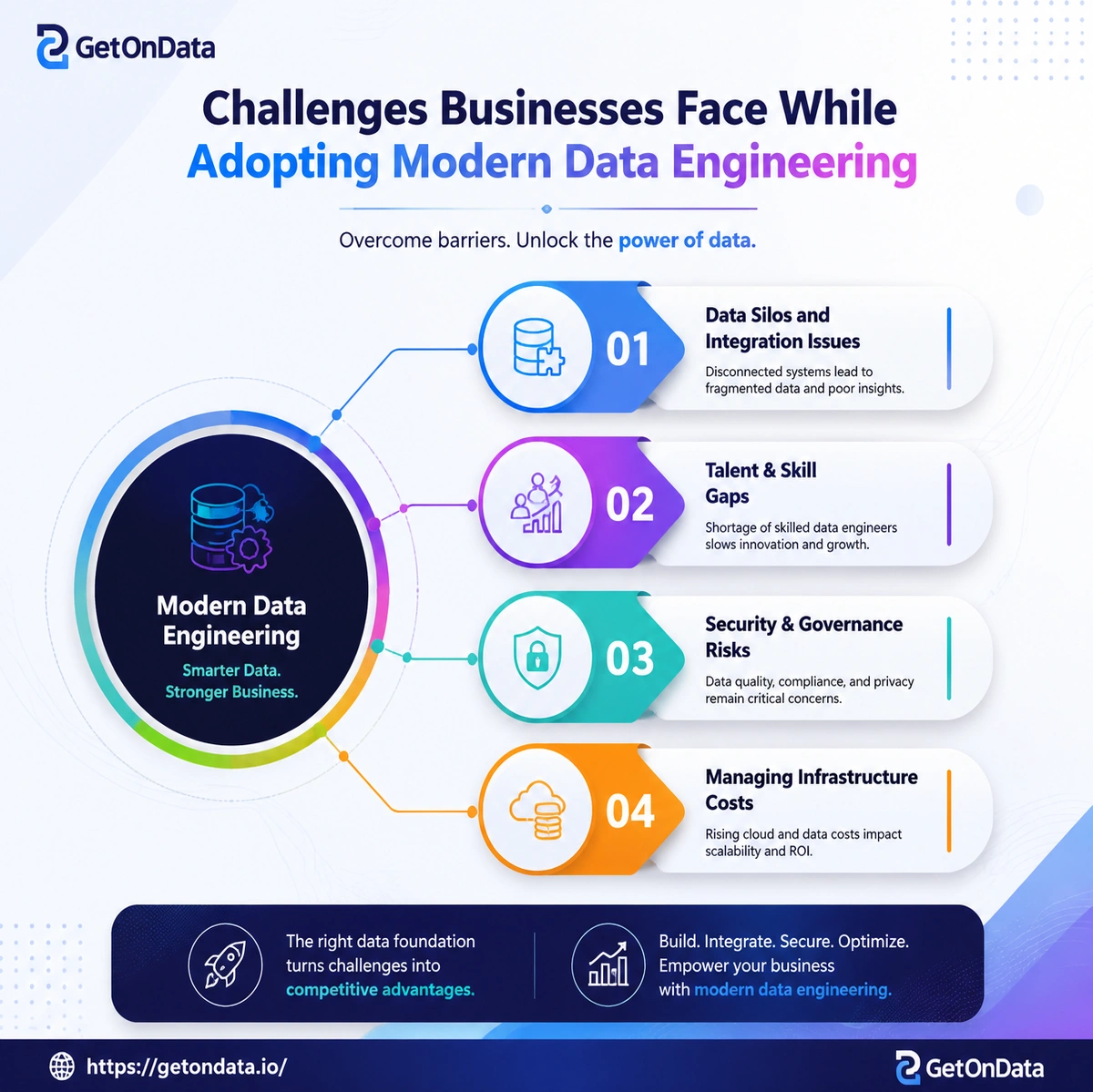
Challenges Businesses Face While Adopting Modern Data Engineering
✦ Data Silos and Integration Issues
Organizations often struggle with disconnected data systems & integration challenges while adopting advanced data engineering practices. Legacy systems may not support advanced cloud platforms, leading to compatibility errors. Cross-platform synchronization becomes complicated when managing multiple apps, databases, and data sources. It results in inconsistent data, delayed reporting, and limited operational efficiency across departments.
✦ Talent & Skill Gaps
Advanced data engineering demands highly skilled professionals skilled in cloud platforms, automation, AI, and analytical systems. Most of the firms face a lack of a skilled team capable of managing modern data architectures. The rising demand for professionals in AI and data engineering makes recruitment tough and slows down the virtual transformation initiatives for firms.
✦ Security & Governance Risks
Data security and governance remain major concerns for organizations implementing modern data engineering solutions. Businesses must comply with evolving privacy regulations while safeguarding crucial user data. Weak governance frameworks, unauthorized access, and poor monitoring systems can increase the risk of data breaches, compliance violations, and loss of customer trust.
✦ Managing Infrastructure Costs
Infrastructure management expenses are a significant challenge as an organization scales advanced data engineering environments. Processing, cloud storage & streaming workload can smartly improve operational cost without optimization. Most of the firms depend on data engineering consulting solutions to uplift workload efficiency, optimize resources, and minimize cloud investment while managing scalable data operations.
Also Read: Power BI Consultant in USA for Scalable Business Intelligence Solutions
Best Practices for Building Future-Ready Data Engineering Systems
➔ Invest in Scalable Architecture
Firms must build scalable data engineering systems using cloud-native infrastructure and flexible compute environments. Advanced architectures must support rising data volumes, real-time processing, and multi-cloud operations. Scalable storage & processing system enhances performance, allowing firms to quickly adapt to changing firm and tech demands.
➔ Prioritize Data Quality
Managing data quality is crucial for accurate analytics and reliable firm decisions. The firm must implement a frequent validation process, a real-time tracking system, and automated quality inspection. Data observability tools support tracking inconsistencies, missed records, and anomalies. It ensures trustworthy data pipelines while enhancing the accuracy of analytics and reporting outcomes.
➔ Embrace Automation
Automation supports firms in streamlining data engineering operations and limiting manual work. AI-based pipeline management optimizes processing, monitors errors, and enhances operational efficiency automatically. Automated QA & deployment practices support quick release, reducing the chances of errors. It supports frequent integration, allowing firms to manage data systems efficiently.
➔ Build Strong Governance Policies
Strong governance policies support firms in managing data security, operational consistency, and compliance. Firms must implement RBA controls, encryption standards, and clear compliance frameworks to safeguard crucial data. Effective governance enhances accountability, supports compliance requirements, and verifies secure and responsible data usage across enterprise systems.
➔ Enable Cross-Team Collaboration
The future-ready data engineering system demands collaboration between technical & business teams. Shared data ownership encourages accountability & enhances data accessibility across departments. Self-service analytics platforms allow teams to access and measure data independently, limit reliance on the centralized team while enhancing decision speed, operational efficiency, and organizational collaboration.

Ready to Build an AI-Driven & Real-Time Data Ecosystem?
The data engineering trends 2026 mentioned above reflect an innovative journey to move towards a future where data is handled efficiently. Organizations that modernize their data infrastructure today lead to tomorrow’s AI-driven economy. If you want to invest in secure, scalable, and AI-ready engineering practices, hire data engineering services.

